


Alexander Robert Reinagle was an English-born composer and organist who rose to fame and popularity in the United States. His work was notably influenced by Haydn, Clementi, and his teacher, Rayner Taylor. He was fortunate enough to meet and befriend Mozart during his time in London. As a young man, Alexander was unsure about pursuing a creative career. It wasn’t until he moved to the U.S. that he was able to fully realize his potential in Philadelphia. Read on to learn more about how this came to be on philadelphia-trend.
Early Life
Alexander was born in Portsmouth, England, on April 23, 1756. His father was of Hungarian descent and a professional musician. His mother was from Scotland. Alexander also had a brother, Joseph, who grew up in the family.
The boy was taught music from an early age by his father. Later, he was lucky enough to study with Rayner Taylor, who was already a well-known teacher, organist, and composer. Alexander always spoke of his teacher with great respect and admiration. After moving to the U.S., he even invited him to join the burgeoning music scene in the new country.
But that came later. In 1763, Alexander moved to London. A year later, Mozart arrived in the city on tour. The boy was fortunate to meet the famous composer and talk with him.
Despite his musical talent, the young Alexander was unsure if he should pursue a career in music. Throughout the 1770s, he earned a living in the shipping industry. It was during this time that he first visited America and began to consider moving to the New World. He eventually returned to Edinburgh, where he taught music and performed in concerts. This is also when Alexander began to write his own music. His works were published in Glasgow and reached the distant colonies in America, where they became popular. So, their creator followed them across the Atlantic in search of a better life.
The Journey to America and Musical Career
In 1786, Alexander finally decided to pursue a professional music career. To do so, he moved to the U.S., settling in New York. He later chose Philadelphia as his home and creative hub, where a vibrant cultural scene offered many opportunities at the time. In the 1790s, the ambitious Englishman joined the local music community and helped revitalize it. He performed concerts featuring the music of Haydn and Mozart, as well as his own compositions.
One of his admirers was U.S. President George Washington:
- In 1789, the composer wrote a “Chorus” that was performed for the president in Trenton, New Jersey, on his way to his inauguration.
- In Philadelphia, Washington’s step-granddaughter became a student of the British composer.
- Washington frequently attended musical events and particularly enjoyed Alexander’s concerts.
After the president’s death, he composed a monody in his honor.
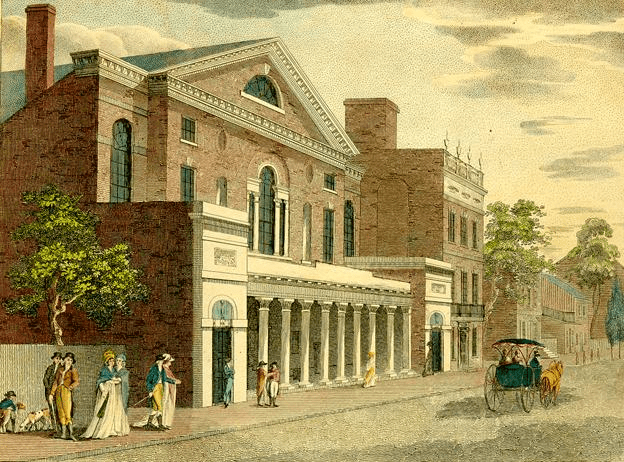
In Philadelphia, the composer collaborated with theater manager Thomas Wignell. Together with the New Company, they created ballets for the Chestnut Street Theatre. This collaboration resulted in over 75 programs. Additionally, Alexander’s teacher, Rayner Taylor, moved to Philadelphia. The two composers stayed in touch and organized joint musical events.
After Thomas Wignell died in 1803, Reinagle moved to Baltimore, Maryland. There, he collaborated with the local theater, creating music for productions. The composer passed away in that city on September 21, 1809. He was buried in the Old Saint Paul’s Cemetery.
Alexander Reinagle’s Musical Legacy

The first works Alexander Reinagle wrote in Edinburgh included cello duets and various variations on Scottish melodies. These were the compositions published in Glasgow and later in Philadelphia. The composer also created “Twenty-Four Short and Easy Lessons,” which were instructional pieces for keyboard instruments. Alexander later used them extensively in his teaching.
After moving to the U.S., Reinagle composed short works dedicated to various special events. Sometimes he dedicated them to American ideals or prominent figures. This is how pieces like “Federal March,” “President Madison’s March,” and “Mrs. Madison’s Minuet” came about. Their sound resembled the dance music of the time and they became popular.
During this period, the composer also wrote four keyboard sonatas. They were created after his first visit to Philadelphia, so they are also known as the “Philadelphia Sonatas.” These were the first such works he wrote in the U.S. Each sonata consisted of two or three movements. They showcased Alexander’s individual approach and creative style, yet still showed the clear influence of Bach, who was one of Reinagle’s idols. Interestingly, it was with Bach that Alexander compared his own teacher, Rayner Taylor.
Unfortunately, when the Chestnut Street Theatre building was destroyed by fire in 1820, a large part of Alexander Reinagle’s musical legacy was lost. However, many works still remain. By listening to them, we can learn about the creativity and uniqueness of this man who bravely set out to conquer the musical world of the United States and succeeded.